Mazecare
AI MODULE & STANDALONE - CLINICS & HOSPITAL

Patient Flow,
Triage & Queues.

An AI Triage Agent for Clinical Assessment, Smart Routing & Virtual Queues. A full AI-assisted triage station that helps nurses evaluate patients and assign acuity categories (ESI, CTAS, MTS). Dynamically manages virtual queues so patients can wait remotely with real-time ETAs. Automatically routes patients to the right provider, room, or ED bay based on triage priority and real-time load.

Patient Flow, Triage & Queues.

Works across care settings via open API

HL7 FHIR

REST APIs

Any PMS / EHR

ED Tracking

Vitals Monitors

Mazecare OS

Two Modes, One Platform

Clinical triage meets intelligent queuing.

Whether you are a polyclinic managing walk-in queues or a hospital ED triaging emergency patients, the same AI engine adapts to your environment with the right workflow for each setting.

Hospital & ED Mode

Full Triage Station + Queue Management

A clinical decision support workstation for triage nurses. AI evaluates chief complaint, vitals, patient history, and risk factors, then suggests an acuity category using ESI, CTAS, MTS, or your custom scale. The nurse reviews the AI's reasoning and risk flags, then confirms, adjusts, or overrides. The confirmed triage category feeds directly into the priority queue and routing engine.

  • AI-suggested triage category with full clinical reasoning
  • Vitals capture via monitors, devices, or manual input
  • Risk flags: cardiac, sepsis, pediatric, stroke protocols
  • Nurse confirms or overrides — always the final decision-maker
  • Re-triage alerts for deteriorating waiting patients
  • Direct routing to ED bay, resuscitation room, or fast-track
  • Full audit trail of every triage decision

Clinic & Polyclinic Mode

Smart Check-In + Virtual Queue

Automated triage at check-in for clinic environments. AI evaluates appointment type, visit reason, acuity indicators, and real-time provider load to prioritize patients intelligently — not first-come-first-served. Patients wait remotely with real-time ETAs and are called when it is their turn.

  • Automated triage at check-in (kiosk, mobile, or front desk)
  • Priority queuing based on acuity and appointment type
  • Virtual waiting room with live ETA on patient's phone
  • Smart routing to provider, room, or service line
  • Dynamic load balancing across all available providers
  • Multi-step visit orchestration (consult → lab → pharmacy)
  • Replaces paper tickets and manual queue management
Capabilities

Intelligent triage and flow, not ticket numbers.

Traditional systems assign ticket numbers and leave clinical triage on paper. Mazecare's AI understands who needs to be seen, how urgently, by whom, and adapts in real-time as conditions change.

AI-Assisted Triage Station

A full clinical triage workstation for nurses. AI evaluates chief complaint, vitals, and patient history to suggest an acuity category (ESI, CTAS, MTS, or custom). The triage nurse reviews, confirms, or overrides with full clinical reasoning displayed. Reduces triage time while improving consistency and accuracy across shifts.

Vitals & Risk Scoring

Integrates with bedside monitors, manual input, or connected devices to capture vitals in real-time. AI cross-references vitals against chief complaint, age, and medical history to flag high-risk presentations — chest pain with tachycardia, pediatric fever with altered mental status, or sepsis screening criteria.

Smart Check-In & Triage

In clinic settings, patients are triaged at check-in based on acuity, appointment type, and real-time provider load. In hospital EDs, the triage nurse uses the full triage station to assess and categorize patients. Both paths feed into the same intelligent queue.

Virtual Queue Management

Patients wait remotely and receive real-time ETAs on their phone. No crowded waiting rooms, no paper ticket numbers. Patients arrive when it is their turn. Particularly valuable in Asia where high-traffic polyclinics have physically small waiting areas.

Smart Patient Routing

AI automatically routes patients to the right provider, room, ED bay, or service line based on triage category, provider availability, and current queue state. Multi-step visits (triage → consult → lab → pharmacy) are orchestrated as a single flow.

Dynamic Load Balancing

When bottlenecks form, AI redistributes patients across available providers in real-time. If one provider is running behind, patients are proactively rerouted to less loaded providers, maintaining throughput and keeping ETAs accurate.

Escalation & Re-Triage Alerts

AI monitors waiting patients for deterioration signals. If a patient's condition may be worsening based on wait time, re-triage protocols, or updated vitals, the system alerts the triage nurse for reassessment. ESI Level 3 patients waiting beyond thresholds are flagged automatically.

Real-Time ETA Transparency

Live, continuously updated wait time estimates for every patient in the queue. ETAs are recalculated based on actual consultation durations, queue movement, provider pace, and triage priority — not static guesses.

Capacity Planning Analytics

Historical flow and triage data powers data-driven capacity planning. See triage category distributions, peak hours, average door-to-provider times, wait times by acuity level, and no-show patterns. Staff smarter and eliminate bottlenecks before they form.

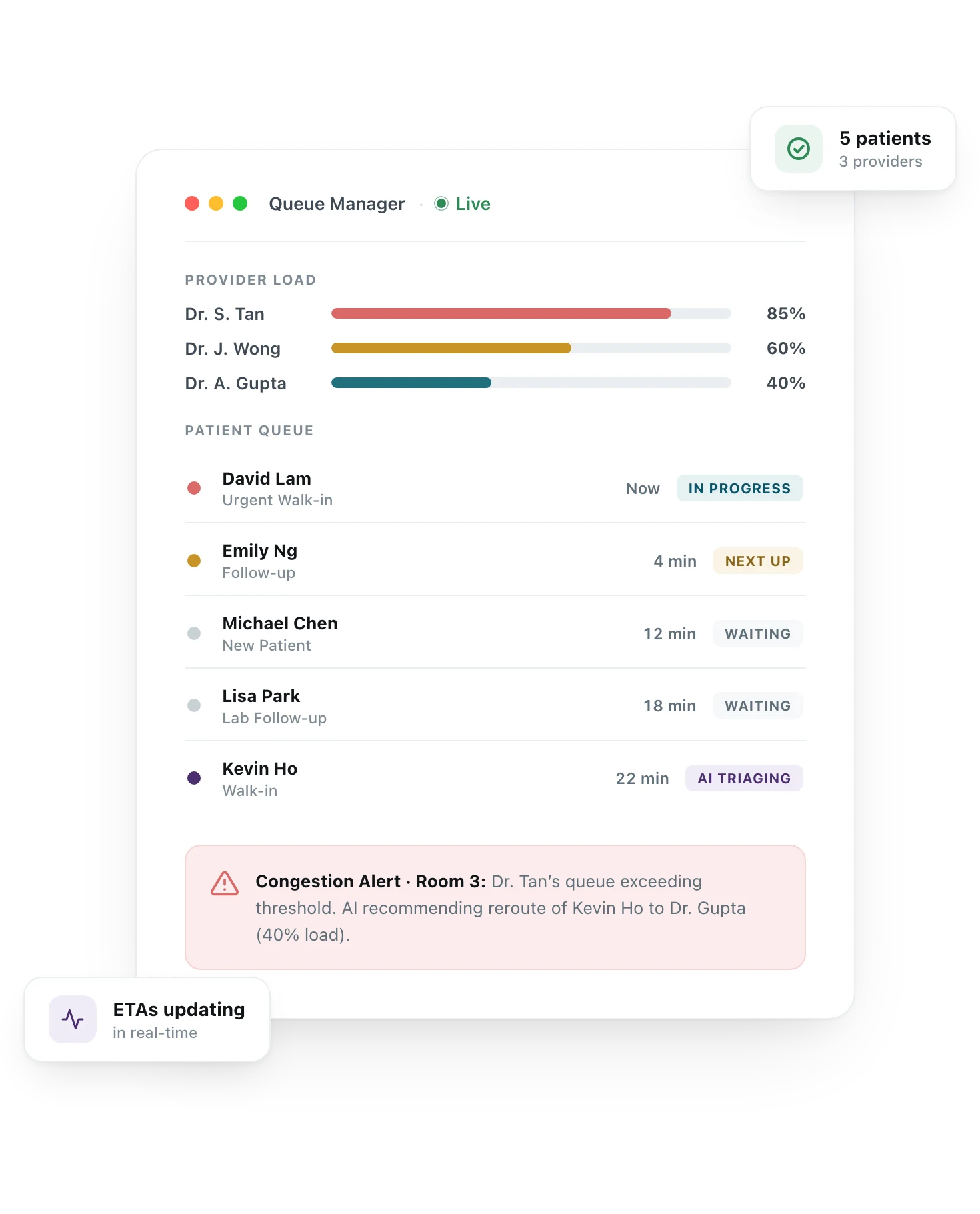
How It Works

From arrival to seen, orchestrated by AI.

Whether patients arrive at an ED or a polyclinic, the AI manages the entire journey through triage assessment, prioritized queuing, intelligent routing, and dynamic rebalancing.

Key Impact

Better triage. Shorter waits. Safer care.

Measurable value for patients, nurses, providers, and operations across both hospital and clinic settings.

85-92%

AI-nurse triage agreement

AI-suggested triage categories match expert nurse assessment 85 to 92 percent of the time. The nurse always confirms, but AI reduces cognitive load, improves consistency across shifts, and catches edge-case risk flags that might be missed under pressure.

30-50%

Reduction in average wait times

AI-driven prioritization and dynamic load balancing cut average wait times by 30 to 50 percent compared to first-come-first-served systems. Benchmarked against Qventus and LeanTaaS methodologies.

Virtual

No more crowded waiting rooms

Patients wait remotely with real-time ETAs. They arrive when it is their turn. Transparent wait times reduce anxiety, improve satisfaction scores, and make small waiting areas viable for high-volume facilities.

Asia-First

Built for high-traffic facilities

High-traffic polyclinics, hospital EDs, and GP chains across Asia struggle with unpredictable congestion. AI-driven triage and flow replaces the chaos of paper ticket numbers and manual triage with intelligent, real-time orchestration.

Triage Intelligence

AI that thinks alongside the triage nurse.

Not a replacement. A clinical decision support layer that brings consistency, speed, and an extra layer of safety to every triage decision.

What the AI evaluates

Chief Complaint Analysis

Natural language understanding of the patient's presenting complaint. Maps free-text descriptions to standardized clinical categories and identifies high-risk keywords (chest pain, difficulty breathing, altered consciousness).

Vital Signs Correlation

Cross-references captured vitals (BP, HR, SpO₂, temp, RR, pain score) against the chief complaint, age, and sex to identify danger patterns — tachycardic chest pain, febrile neutropenia, hypotensive trauma.

Patient Context

Pulls available medical history, medication list, allergies, and recent visits to contextualize the presentation. A patient on blood thinners presenting with a fall is flagged differently than a healthy 25-year-old.

Protocol-Based Risk Flags

Runs the presentation through configurable clinical protocols — HEART score, sepsis screening (qSOFA/SIRS), stroke (BE-FAST), pediatric early warning, fall risk — and surfaces specific flags with explanations.

What the triage nurse gets

Suggested Acuity Category

A clear recommendation — ESI Level 2, CTAS III, MTS Orange — with the specific criteria met and the clinical reasoning behind it. Not a black box. The nurse sees exactly why the AI arrived at its suggestion.

Risk Flags & Alerts

Specific, actionable flags: 'Cardiac risk — chest pain + tachycardia + male > 50', 'Sepsis screening positive — qSOFA ≥ 2'. These surface even if the nurse might have arrived at the same triage level — they ensure nothing is missed.

One-Click Confirm or Override

The nurse can confirm the AI suggestion with one click, adjust to a different level with a reason code, or override entirely. Every decision is logged with the AI suggestion, nurse decision, and rationale for full audit trail and governance.

Re-Triage Monitoring

For patients still waiting, the system tracks time-since-triage against protocol thresholds and monitors for any updated vitals or condition reports. If re-assessment is warranted, the nurse is alerted proactively — not relying on the patient to speak up.

Supported Triage Scales
ESI 1
Resuscitation
ESI 2
Emergent
ESI 3
Urgent
ESI 4
Less Urgent
ESI 5
Non-Urgent

Also supports CTAS (Canadian), MTS (Manchester), and custom organization-defined scales. Configurable per facility or department.

Integration

Layer intelligent triage and flow on top of your current stack.

Add AI-powered triage, virtual queues, and smart routing on top of your existing PMS, EHR, or ED tracking system via open API. Or run everything natively on Mazecare OS.

Standalone via Open API

Integrate the AI Triage & Patient Flow module into your current PMS, EHR, or ED tracking system via REST APIs and HL7 FHIR. Send patient arrival events and vitals in, receive triage suggestions, queue positions, ETAs, and routing assignments out. Vitals can flow from connected monitors or manual entry. Typical integration: 1 to 3 weeks.

Native on Mazecare OS

Run Triage, Patient Flow & Queues as part of the full Mazecare operating system. When paired with the AI Clinical Assistant, triage assessments flow directly into the clinical encounter. When paired with AI Scheduling, the entire arrival-to-discharge journey is a single connected workflow. Go live in days.

Mazecare
Maximum Flexibility

AI Model Agnostic. Your AI, Your Choice.

Choose, combine, or bring your own models for triage logic, queue optimization, risk scoring, and capacity planning.

Pre-integrated Models

Healthcare-optimized AI models for triage assessment, routing, and queue optimization, ready to deploy out of the box.

Open-source Models

Deploy open-source clinical models within your own infrastructure for full data sovereignty over patient triage data.

Custom Fine-tuned Models

Train models on your own triage data, provider pace patterns, and patient population for hyper-accurate assessments.

Bring Your Own API

Connect any external clinical decision support API. Use your existing enterprise agreements and preferred AI providers.

Mix and match models across modules. No vendor lock-in, ever.
How We Compare

AI triage + intelligent flow + a full operating system.

The only platform that combines clinical triage decision support with intelligent queue management, and also offers its own AI-native OS.

Feature
Queue Platforms
Triage Software
Legacy Ticket
Manual / Paper
MazecareMazecare
AI-assisted nurse triage station (ESI/CTAS/MTS)No AI
AI-suggested acuity with nurse overrideNo AI
Vitals integration + risk scoringPartial
Escalation & re-triage alertsManual
Virtual queue with real-time ETADisplay Only
Smart routing to provider/room/ED bayPartial
Dynamic load balancing across providersLimited
Real-time ETA recalculationStatic
Multi-step visit orchestrationLimited
Walk-in + appointment unified queuePartialSeparate SystemFIFO OnlyManual
Patient mobile notificationsLimited
Capacity + triage analyticsPartialBasicBasic
Clinical-to-queue data continuityPartial
FHIR-native interoperabilityLimitedLimited
Open API for any PMS/EHRLimitedPartialPartial
Asian polyclinic / high-traffic supportLimitedLimitedLimitedManual✓ Native
AI model agnostic (bring your own)
Own AI-native OS (clinical, scheduling, billing, flow)✓ Mazecare OS
FAQ

Frequently asked questions.

The triage station is a full clinical workstation designed for triage nurses in hospital emergency departments and urgent care settings. When a patient arrives, the nurse enters the chief complaint (or it is captured via patient-facing intake), captures vitals (manually or via connected devices), and reviews any available medical history. The AI then analyzes all inputs — chief complaint, vitals, age, sex, medical history, medication list — and suggests an acuity category using the configured triage scale (ESI, CTAS, MTS, or custom). The nurse sees the AI's reasoning, including specific risk flags and clinical rationale, and then confirms, adjusts, or overrides the suggested category. The nurse is always the final decision-maker. The AI acts as a clinical decision support layer that improves consistency and speed, not a replacement for clinical judgment.

Mazecare supports the Emergency Severity Index (ESI 1 to 5), Canadian Triage and Acuity Scale (CTAS), Manchester Triage System (MTS), and custom organization-defined scales. You can configure which scale is used per facility, per department, or per workflow. The AI adapts its suggestion logic to match the selected scale's criteria and decision points.

Yes. The system continuously monitors waiting patients against time-based re-triage protocols and any updated vitals. If a patient categorized as ESI Level 3 has been waiting beyond the configured threshold, or if new vitals are entered that suggest deterioration, the system alerts the triage nurse for reassessment. This is particularly important in busy EDs where patients can wait for extended periods and their condition may change.

Standalone triage systems handle assessment and categorization but typically stop there. The patient gets a category, then a separate queue or tracking system takes over. Mazecare integrates triage directly into the patient flow engine — the triage assessment feeds directly into the priority queue, the routing logic, and the ETA calculations. There is no gap between triage and queue, no re-keying information, and no separate systems to manage. When the triage nurse confirms ESI Level 2, the patient is immediately routed to the appropriate ED bay with the right provider notified, all within the same workflow.

Yes. Once triaged, patients receive a real-time ETA on their phone via SMS, WhatsApp, or the patient portal. They can wait at a nearby café, in their car, or anywhere they prefer. When their turn approaches, they receive a notification to come in. This eliminates crowded waiting rooms and is particularly valuable in Asian markets where high-traffic polyclinics and GP chains often have physically small waiting areas. For ED patients with higher acuity, the system routes them directly to a bay rather than a virtual queue.

The AI manages walk-ins and scheduled appointments in a unified queue. Scheduled appointments are given their reserved time slots while walk-ins are intelligently slotted into gaps based on triage priority, provider availability, and acuity. If a walk-in has higher acuity than a scheduled follow-up, the AI prioritizes accordingly while minimizing disruption to the appointment schedule. In ED settings, all patients flow through the triage station regardless of arrival method.

The AI detects provider delays in real-time and responds immediately. All downstream ETAs are recalculated and communicated to waiting patients. If the delay is significant, the AI proactively recommends or automatically reroutes patients to less loaded providers, subject to clinical appropriateness and triage category. This dynamic load balancing prevents cascade delays where one slow consultation creates a bottleneck that affects the entire department.

Yes. The Patient Flow, Triage & Queues module integrates with any existing PMS, EHR, ED tracking system, or queue management system via REST APIs and HL7 FHIR. Vitals can be captured from connected bedside monitors, manual entry, or via device APIs. You can layer AI-driven triage and routing on top of your current workflow without replacing anything. If you prefer a fully integrated experience, run it natively on Mazecare OS where scheduling, clinical, billing, and patient flow are already connected.

AI triage suggestions are trained on validated clinical decision support frameworks aligned to ESI, CTAS, and MTS criteria. In internal benchmarks, the AI's suggested category matches expert triage nurse assessment 85 to 92 percent of the time, with the majority of disagreements being one level apart. Critically, the AI is designed as decision support — the triage nurse always reviews the suggestion, the clinical reasoning, and the risk flags before confirming. The system learns from each nurse override to improve accuracy over time for your specific patient population.

Mazecare is designed to meet healthcare compliance requirements including PDPO (Hong Kong), PDPA (Singapore/Thailand), and international standards. All triage assessments, vitals, and queue data are encrypted in transit and at rest, with full audit trails and role-based access controls. Patient-facing queue displays show only position and ETA without exposing clinical details. Every triage decision, including AI suggestion and nurse confirmation or override, is logged with timestamps for clinical governance and audit purposes. On-premise and private cloud deployment options are available.

Ready to transform triage and eliminate the waiting room?

See the AI Triage & Patient Flow module in action with your own facility layout, triage protocols, provider roster, and patient volumes. Works with your existing systems or as part of Mazecare OS.