Mazecare
AI MODULE & STANDALONE - CLINICS & HOSPITAL

Claims, Eligibility
& Pre-Authorization.

Your AI Coding Agent for Clean Claim Submissions. AI auto-codes every encounter with ICD-10, ICD-11, SNOMED CT, CPT, and HCPCS. Validates claims against payer-specific rules before submission. Verifies eligibility in real-time. Assembles and submits electronic pre-authorization requests. Goal: first-pass clean claim rate above 95%.

Claims, Eligibility & Pre-Authorization.

Coding standards and integrations

ICD-10 / ICD-11

SNOMED CT

CPT / HCPCS

LOINC

HL7 FHIR

REST APIs

Any PMS/EHR

Mazecare OS

The Problem

Every rejected claim costs time, revenue, and trust.

Across Asia, most providers still code manually, submit claims via PDF or email, and wait days or weeks for outcomes. The result is predictable.

15-25% — Average claim denial rate

Manual coding errors, missing documentation, and incorrect payer formats cause one in five claims to be denied on first submission.

30+ days — Average days in A/R

Denied claims require investigation, correction, and resubmission. Each rework cycle adds days to the revenue cycle and costs administrative hours.

Manual — Coding and submission process

Most providers in Asia still rely on manual ICD-10 lookup, paper-based pre-auth forms, and email-based claim submission to insurers.

Zero — Real-time visibility

Once a claim is submitted, providers have no visibility into its status until the insurer responds, which can take days, weeks, or months.

Three Pillars

Code. Validate. Get paid.

Three capabilities that work together to eliminate the gap between clinical care and revenue realization.

Pillar 01

AI Coding and Claim Assembly

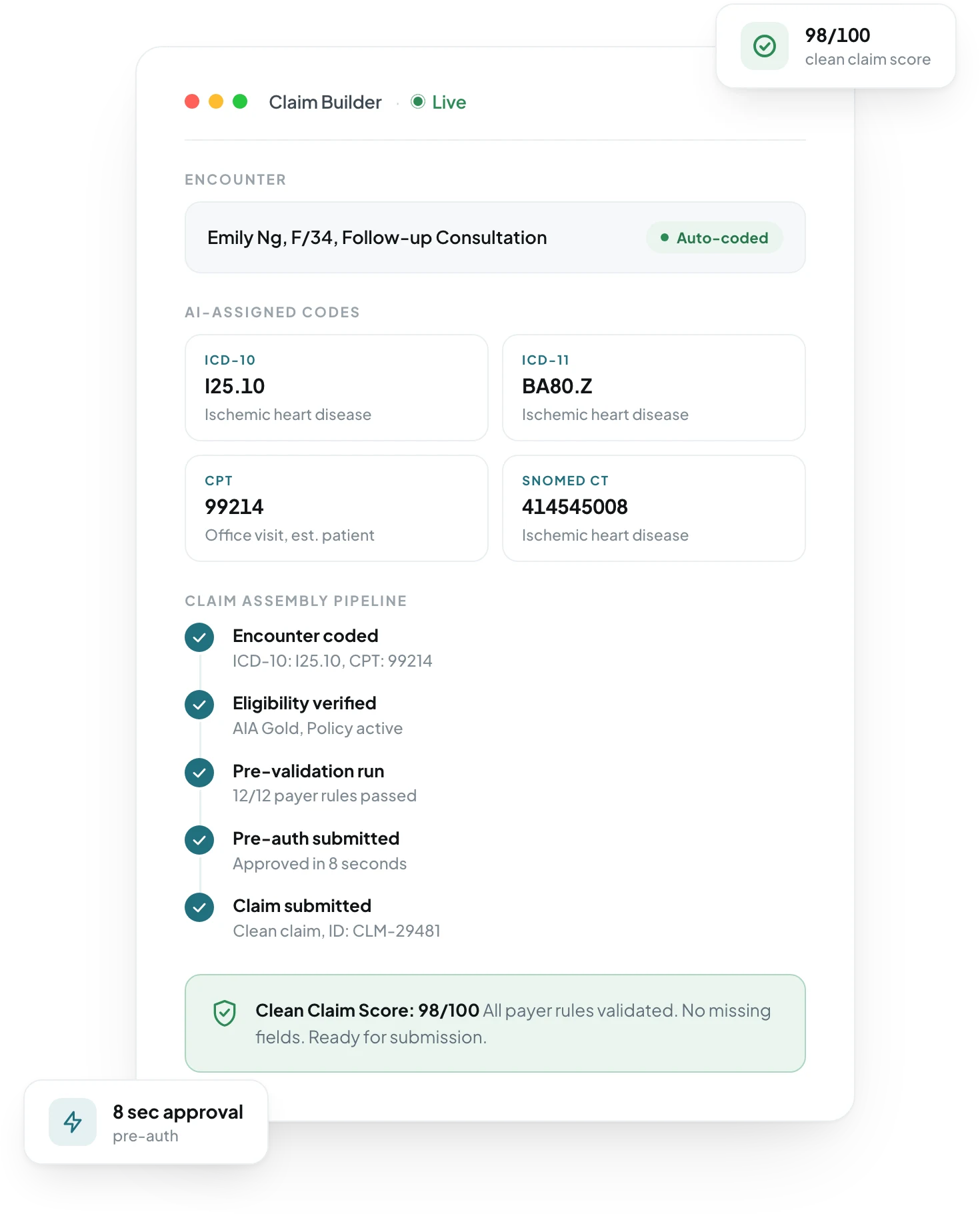
Every encounter is auto-coded with full specificity across ICD-10, ICD-11, SNOMED CT, CPT, and HCPCS. Claims are assembled with all required fields, validated against payer rules, and scored for submission readiness.

  • Multi-system coding from clinical notes in seconds
  • Code sequencing, modifier logic, and bundling compliance
  • Payer-specific rule validation before submission
  • Clean claim score with actionable fix suggestions
  • Supports both professional (CMS-1500) and institutional (UB-04) claims
Pillar 02

Real-Time Eligibility Verification

Know before the encounter whether the patient is covered, what their benefits are, and what they will owe out of pocket. No more post-visit surprises for patients or providers.

  • Instant coverage verification via payer API
  • Remaining benefits, deductibles, and co-pay details
  • Pre-existing condition and waiting period checks
  • Pre-auth requirement detection for planned procedures
  • Patient cost estimate before treatment begins
Pillar 03

Electronic Pre-Authorization

AI assembles pre-auth requests from encounter data, attaches clinical justification and supporting documents, and submits electronically. No more fax machines, phone calls, or portal logins.

  • Auto-detection of procedures requiring pre-auth
  • AI-assembled clinical justification from encounter notes
  • Supporting documents compiled and attached automatically
  • Electronic submission to payer with tracking
  • Approval likelihood prediction before submission
Capabilities

Every step from encounter to payment, powered by AI.

Not just a billing tool. A complete revenue cycle intelligence layer that codes, validates, submits, tracks, and optimizes every claim.

AI Auto-Coding Engine

Every encounter is automatically coded with the correct ICD-10, ICD-11, SNOMED CT, CPT, HCPCS, and LOINC codes. AI reads clinical notes, diagnoses, procedures, and lab results, then assigns the most specific and accurate codes. Supports multi-code encounters with proper sequencing and modifier logic.

Pre-Submission Validation

Before any claim is submitted, AI runs it through payer-specific rule engines that check for missing fields, incorrect code combinations, bundling errors, medical necessity requirements, and documentation gaps. Every issue is flagged with a clear explanation and suggested fix. The goal: first-pass clean claim rate above 95%.

Real-Time Eligibility Verification

Verify patient coverage, benefits, deductibles, co-pays, remaining limits, pre-existing condition status, and pre-auth requirements in real-time before the encounter begins. No more surprise denials after the visit. Works with major insurers across Hong Kong, Singapore, and the wider Asia-Pacific region.

Electronic Pre-Authorization

AI assembles pre-auth requests from encounter data, attaching clinical justification, supporting documents, and procedure-diagnosis alignment. Requests are submitted electronically to payers. AI predicts approval likelihood based on payer history and documentation strength, and flags requests that need additional support.

Real-Time Claims Adjudication

For payers on the Mazecare network, claims are adjudicated in real-time at the point of care. The provider knows instantly whether the claim is approved, what the patient owes, and what the insurer will pay. No more waiting days or weeks for claim outcomes.

Payer-Specific Rule Engine

Each insurer has different requirements for documentation, coding, bundling, and submission format. The AI maintains payer-specific rule sets that validate every claim against the target insurer's exact requirements. Rules are continuously updated as payer policies change.

Denial Prevention and Recovery

AI analyzes denial patterns across your claims history to identify root causes and prevent future denials. When a claim is denied, AI suggests the most effective appeal strategy, assembles the appeal documentation, and tracks the resubmission. Denial rates drop by 30 to 50% within the first quarter.

Claim Lifecycle Tracking

Full visibility into every claim from creation to payment. Track submission status, payer acknowledgment, adjudication outcome, payment posting, and any denials or requests for information. Every status change is logged with timestamps and visible to the billing team in real-time.

Revenue Cycle Analytics

Dashboards showing clean claim rate, denial rate by payer and reason code, average days in accounts receivable, first-pass resolution rate, coding accuracy metrics, and revenue leakage analysis. Drill down by provider, payer, procedure, or time period to identify and fix revenue bottlenecks.

How It Works

From encounter to payment in four steps.

AI handles the entire claims lifecycle so your billing team can focus on exceptions, not manual data entry.

Key Impact

Fewer denials. Faster payments. Less rework.

Measurable impact on revenue cycle performance, administrative burden, and patient experience.

>95%

First-pass clean claim rate

AI coding accuracy combined with payer-specific pre-submission validation pushes first-pass acceptance above 95%. Benchmarked against Olive AI and Infinitus methodologies. Most providers start between 70 and 80%.

30-50%

Reduction in claim denials

Coding errors, missing documentation, and payer format mismatches are caught before submission. Denial pattern analysis prevents recurring issues. Providers see denial rates drop by 30 to 50% within the first 90 days.

Minutes

Pre-auth turnaround

Electronic pre-authorization replaces phone calls, fax machines, and portal logins. AI assembles the clinical justification automatically. Pre-auth turnaround drops from days to minutes for payers on the Mazecare network.

Asia-First

Generational leap for the region

Most providers across Asia still submit claims via email or PDF. AI-powered electronic submission with pre-validation, real-time eligibility, and auto-coding is a fundamental upgrade for the region's revenue cycle.

Coding Intelligence

Every code system. Every encounter. Automatic.

AI reads clinical encounters and assigns the right codes across every standard required by your payers and regulators.

Code systems supported

ICD-10-CM / PCS

International Classification of Diseases, 10th Revision

Diagnosis coding (CM) and inpatient procedure coding (PCS) with full specificity including laterality, episode of care, and seventh character extensions. The global standard for diagnosis-based billing.

ICD-11

International Classification of Diseases, 11th Revision

The next-generation WHO classification system with improved granularity, extension codes, and cluster coding. AI codes encounters in both ICD-10 and ICD-11 simultaneously for future readiness.

CPT

Current Procedural Terminology

Professional service and procedure codes maintained by the AMA. AI assigns the correct CPT code, handles E/M level selection based on documentation complexity, and applies appropriate modifiers.

HCPCS Level II

Healthcare Common Procedure Coding System

Codes for supplies, durable medical equipment, drugs, and services not covered by CPT. AI identifies billable items from encounter documentation that might otherwise be missed.

Clinical terminology and exchange

SNOMED CT

Systematized Nomenclature of Medicine

The most comprehensive clinical terminology system with over 350,000 concepts. AI maps clinical findings, conditions, and procedures to SNOMED CT for semantic interoperability and clinical decision support.

LOINC

Logical Observation Identifiers Names and Codes

Standard codes for laboratory tests, clinical observations, and vital signs. AI codes lab orders and results with LOINC identifiers for seamless data exchange and reporting.

HL7 FHIR

Fast Healthcare Interoperability Resources

All coded data is structured as FHIR resources for interoperability. Claims are generated as FHIR Claim resources, eligibility checks use FHIR CoverageEligibility, and coded encounters map to FHIR Condition, Procedure, and Observation resources.

Custom

Payer-Specific and Regional Code Sets

Configurable support for payer-specific code requirements, regional code sets, and custom mappings. If a payer requires a proprietary procedure code or a local regulatory body mandates a specific classification, AI adapts accordingly.

Coding Flow Example
Clinical Note

"Patient with chronic ischemic heart disease, follow-up visit"

ICD-10
I25.10
ICD-11
BA80.Z
CPT
99214
SNOMED
414545008
Clean Claim
Ready to submit
Real-Time Adjudication

Know instantly. Get paid faster.

Because Mazecare has full insurance capabilities built in, claims on the Mazecare network are adjudicated in real-time at the point of care.

Instant Adjudication

When a claim is submitted to a payer on the Mazecare network, it is processed against the payer's coverage rules, benefit limits, and adjudication logic in seconds. The provider knows the outcome before the patient leaves.

Transparent Cost Breakdown

Provider and patient both see the exact split: what the insurer covers, what the patient owes (co-pay, deductible, co-insurance), and what, if anything, is not covered. No surprises weeks later.

Faster Cash Flow

Real-time adjudication eliminates days in accounts receivable for claims on the network. The provider can collect the patient's share at checkout and receive the insurer's payment on an accelerated cycle.

Works for Non-Network Payers Too

For insurers not yet on the Mazecare network, claims follow the standard electronic submission workflow with full lifecycle tracking. The AI coding, validation, and pre-auth capabilities work for all payers regardless of network status.

Real-Time Adjudication

AIA HK · Live
Claim ID
CLM-29481
Adjudication Status
Approved
Processing Time
2.3 seconds

Payment Breakdown

Total Billed
HKD 2,400
Insurer Pays (AIA)
HKD 1,760
Deductible
HKD 200
Co-Insurance (20%)
HKD 440
Patient Owes
HKD 640

Collect HKD 640 from patient at checkout. Insurer payment scheduled for next business day.

Integration

Layer AI claims intelligence on top of your current stack.

Add AI coding, validation, and submission to your existing PMS or EHR via open API. Or run everything natively on Mazecare OS.

Standalone via Open API

Integrate the Claims and Pre-Auth module into your current PMS, EHR, or billing system via REST APIs and HL7 FHIR. Send encounter data in, receive coded claims, eligibility results, pre-auth statuses, and adjudication outcomes back. Your existing workflow stays intact. Typical integration: 1 to 3 weeks.

Native on Mazecare OS

Run Claims, Eligibility, and Pre-Auth as part of the full Mazecare operating system. Clinical documentation flows directly into coding. Coding flows into claim assembly. Claims flow into submission and tracking. When paired with the AI Clinical Assistant, the entire encounter-to-payment journey is a single connected workflow. Go live in days.

Mazecare
Maximum Flexibility

AI Model Agnostic. Your AI, Your Choice.

Choose, combine, or bring your own models for coding, validation, denial prediction, and revenue optimization.

Pre-integrated Models

Healthcare-optimized AI models for clinical coding, claim validation, and denial prediction, ready to deploy out of the box.

Open-source Models

Deploy open-source clinical NLP and coding models within your own infrastructure for full data sovereignty over patient data.

Custom Fine-tuned Models

Train models on your own claims history, denial patterns, and payer-specific nuances for hyper-accurate coding and prediction.

Bring Your Own API

Connect any external coding engine or clinical decision support API. Use your existing enterprise agreements and preferred providers.

Mix and match models across modules. No vendor lock-in, ever.
How We Compare

AI coding + real-time adjudication + a full operating system.

The only platform that combines AI clinical coding with real-time claims adjudication, and also offers its own AI-native OS for the entire care journey.

Feature
Clearinghouses
Billing Software
RCM Outsource
Manual / Email
MazecareMazecare
AI auto-coding (ICD-10, ICD-11, CPT, SNOMED CT)ICD-10 OnlyPartial
Multi-code system support (HCPCS, LOINC, FHIR)Limited
Payer-specific pre-submission validationRules OnlyBasic
Real-time eligibility verificationPartialPortal Login
Electronic pre-authorization with AI justificationPartialManual
AI approval likelihood prediction
Real-time claims adjudication
Denial pattern analysis and preventionBasicPartial
AI-powered appeal assemblyLimitedManual
Full claim lifecycle trackingPartial
Revenue cycle analytics and dashboardsBasicBasic
Clinical-to-claim data continuityPartial
Asia-Pacific payer network supportLimitedLimitedLimitedManualNative
FHIR-native interoperabilityLimitedLimited
Open API for any PMS/EHRPartialLimitedPartial
AI model agnostic (bring your own)
Own AI-native OS (clinical, scheduling, billing, flow)Mazecare OS
FAQ

Frequently asked questions.

The AI reads the clinical encounter data including provider notes, diagnoses, procedures performed, medications prescribed, and lab results. It then maps these to the most specific and accurate codes across multiple coding systems: ICD-10-CM/PCS for diagnoses and procedures, ICD-11 for international classification, CPT and HCPCS for procedural billing, SNOMED CT for clinical terminology, and LOINC for lab observations. The AI handles code specificity, laterality, sequencing rules, and modifier assignment automatically. Providers can review and adjust any suggested codes before claim submission. The system learns from corrections to improve accuracy over time for your specific practice patterns.

Pre-submission validation runs each claim through the target payer's specific rule set before it is sent. This includes checking for missing or invalid patient demographics, verifying code combinations are valid and not subject to bundling edits (CCI/NCCI), confirming medical necessity documentation supports the billed codes, validating that required modifiers are present and correct, ensuring authorization numbers are attached when required, checking that timely filing deadlines will be met, and confirming the rendering provider is credentialed with the target payer. Every issue found is flagged with a plain-language explanation and a suggested fix. Claims that pass all validations receive a clean claim score.

When a patient checks in or before an encounter begins, the system queries the payer's eligibility API in real-time using the patient's insurance information. Within seconds, you receive confirmation of policy status, plan type, coverage details, remaining benefits, deductible status, co-pay and co-insurance amounts, pre-existing condition exclusions, and whether the planned service requires pre-authorization. This eliminates the scenario where a provider completes an encounter only to discover the patient's coverage has lapsed or the service is not covered. For payers that do not support real-time API queries, the system falls back to batch verification with cached results clearly marked.

When a procedure or service requires pre-authorization, AI automatically detects this based on the payer's requirements and the planned procedure codes. It then assembles the pre-auth request by extracting clinical justification from the encounter notes, attaching relevant supporting documents like lab results, imaging reports, and prior consultation notes, and formatting everything according to the payer's specific submission requirements. The request is submitted electronically to the payer. AI also predicts the likelihood of approval based on historical approval patterns for the same payer, procedure, and diagnosis combination. If the prediction suggests a low approval probability, the system flags specific documentation gaps or alternative approaches before submission.

For insurers on the Mazecare network, claims can be adjudicated at the point of care rather than days or weeks later. When the provider submits the claim, it is instantly processed against the payer's coverage rules, benefit limits, and adjudication logic. Within seconds, the provider knows the exact amount the insurer will pay, the patient's out-of-pocket responsibility, and whether the claim is approved. This eliminates the uncertainty of traditional claims processing and allows the provider to collect the patient's share at the time of visit. Real-time adjudication requires the payer to be integrated with the Mazecare platform. For other payers, claims follow the standard electronic submission and tracking workflow.

Denial prevention works at multiple levels. First, AI auto-coding reduces coding errors, which are the number one cause of denials. Second, pre-submission validation catches payer-specific issues before the claim is sent. Third, eligibility verification prevents claims for patients with inactive or insufficient coverage. Fourth, denial pattern analysis examines your historical claims data to identify systematic issues, like a specific code combination that a particular payer consistently denies, and proactively flags future claims that match those patterns. When denials do occur, AI analyzes the denial reason code, suggests the most effective appeal strategy, assembles the appeal documentation, and tracks the resubmission through to resolution. Providers using the full system typically see denial rates drop by 30 to 50% within the first 90 days.

The platform supports ICD-10-CM and ICD-10-PCS for diagnosis and procedure coding, ICD-11 for international classification, CPT (Current Procedural Terminology) for professional services, HCPCS Level II for supplies and additional services, SNOMED CT for clinical terminology and interoperability, LOINC for laboratory observations, and FHIR resource coding for data exchange. The AI maps between these systems automatically, so a single clinical encounter generates the correct codes across all required systems for the target payer. Custom code mappings for region-specific or payer-specific code sets can be configured.

Yes. The platform is built with the Asia-Pacific insurance landscape as a primary focus. Most providers across Hong Kong, Singapore, Thailand, and the broader region still submit claims via email, PDF, or insurer portals. Mazecare replaces this with electronic submission, real-time eligibility checks, and AI-powered pre-validation, which represents a generational leap for the region. The system supports payer-specific formats and submission requirements for major insurers including AIA, Prudential, Manulife, Bupa, AXA, Great Eastern, and others. For insurers that have not yet adopted electronic claims APIs, the system generates the required submission documents automatically while maintaining full tracking and analytics.

Yes. The Claims, Eligibility, and Pre-Auth module integrates with any existing practice management system or electronic health record via REST APIs and HL7 FHIR. Send encounter data in, receive coded claims, eligibility results, and pre-auth statuses back. You can layer AI-powered coding, validation, and submission on top of your current workflow without replacing anything. Typical integration takes 1 to 3 weeks. For a fully integrated experience, run it natively on Mazecare OS where clinical documentation, coding, billing, claims, and payment are already connected in a single workflow.

All claims data, patient insurance information, and clinical documentation are encrypted in transit and at rest. The platform meets healthcare compliance requirements including PDPO (Hong Kong), PDPA (Singapore/Thailand), and supports international standards. Full audit trails log every action including who submitted a claim, when codes were modified, and how eligibility was verified. Role-based access controls ensure billing staff, providers, and administrators see only what they need. On-premise and private cloud deployment options are available for organizations with strict data residency requirements.

Ready to stop leaving revenue on the table?

See AI Claims, Eligibility, and Pre-Authorization in action with your own encounter data, payer mix, and billing workflows. Works with your existing systems or as part of Mazecare OS.